Showing posts with label mushroom. Show all posts

Saturday, June 21, 2014

THE CHAGA QUEST

THE CHAGA QUEST
1/12/06  After reading about Chaga in the BMC Bulletin, and checking the Internet to see what it looks like, I went into the park in my back yard and started looking for birch and Chaga.  The first possibility I found on a large old White Birch, about 2' in diameter.  It had several dark spots and knobs and in places the thick bark was missing.  I cut off a piece from one 2" knob and here is what I saw
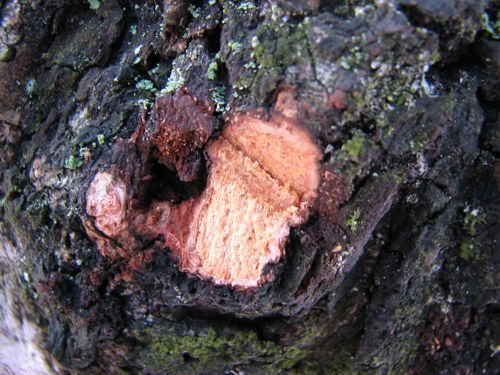
Is it Chaga or no?  There is no sign of clinkers so I don't think this is it.  Later I learned that this is not a Chaga!
Below is one of the dark spots, like a split in the bark, where the bark is missing.
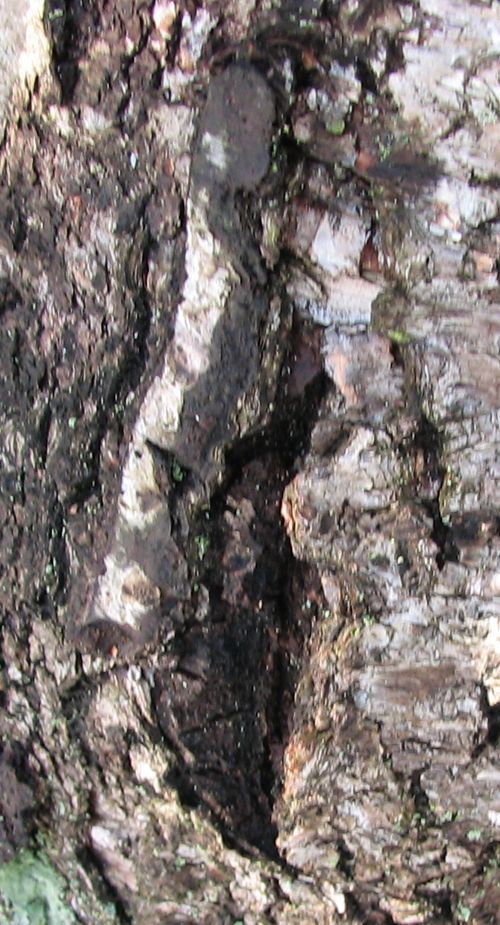
Could this be a place where a Chaga once was?  Wishful thinking!
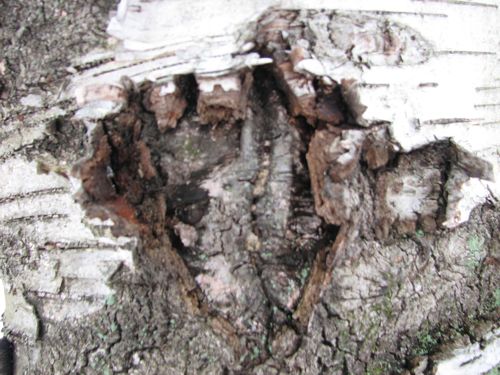
Below is a similar roundish area where the bark is missing and the outer bark pealed back.
 
The other tree is a Sweet Birch (aka Black Birch), (maybe) with what looked like a gall growing out of the tree about 10' up.  I used 12x optical zoom to get a closer look.  On this day the light was bad so I went back the next day to take the picture.
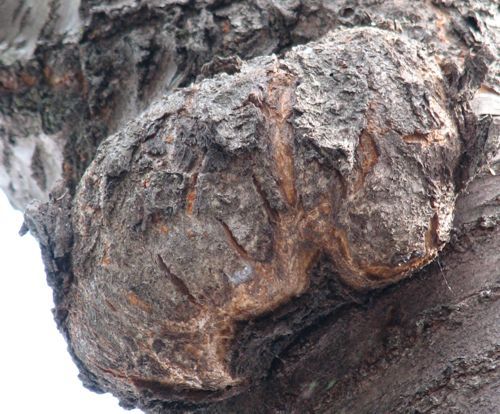
I see no clinkers but the redish brown showing through looks like a Chaga to me.  It is about 8" long by 4" wide and 4" high.  Another false alarm :o)  Later I decided the tree was actually a wild cherry.
Here is a different perspective.
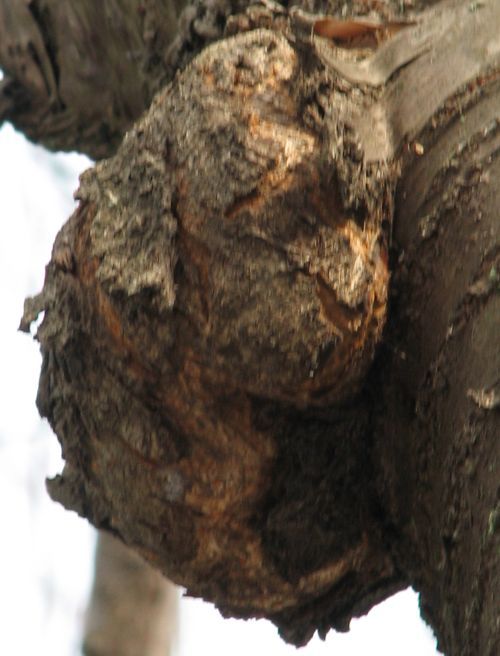
 
1/13/06  I went to Douglas State Forest and took this picture with the 12x telephoto lens.  That fork was about 18' up the tree.  The tree was about 15" in diameter at the base.
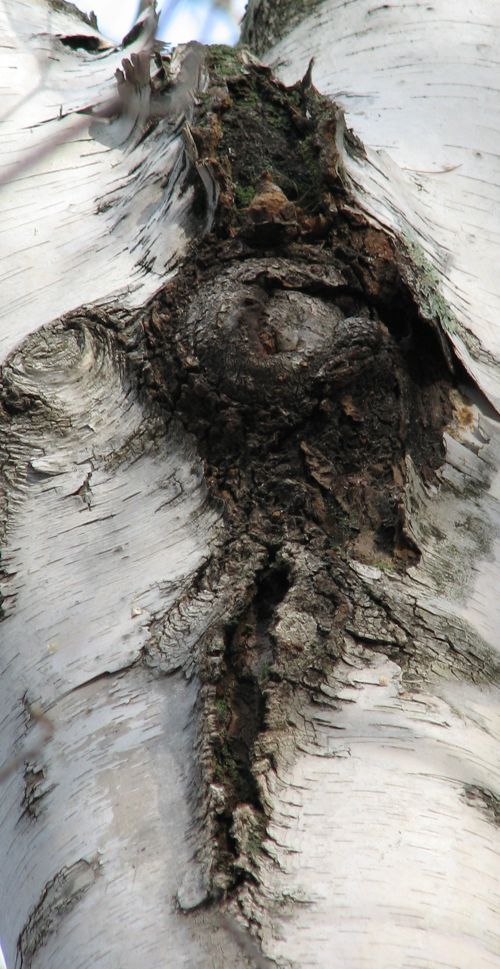
The top part looks like a small Chaga to me.  It was to high up to harvest so it will remain a maybe
Inonotus obliquus? growing on White Birch
 aka clinker polypore
aka Chaga
A large White Birch, over two feet diameter, growing on private property near the road.  About 15' up, on a branch about 8" in diameter is what looks to me like Chaga.  Picture taken at full 12x optical zoom and 5 mp size then cropped and resized and compressed.
A bit from the side
The base of the tree has a rot hole that goes to the center of the tree.

First found a grove of Yellow Birch that were disgustingly healthy, even those about 2' in diameter.  No sign of Inonotus obliquus.
Then I lucked out.  Near a small stream I found countless Yellow Birch and majority showed Nectria galligena damage.  Here is a typical scar:

Notice that the Clinkers grew in the right side of this scar.  On the left and bottom the clinkers are missing.
Here is the same scar but I cut off some of the clinkers to show the orange brown flesh under the black outer part.
Not enough for tea but enough to try as a tinder.  Now I am pretty sure that all those other suspects on White Birch were also Chaga, though too small or out of reach to be useful.  Now to find one large enough to make Chaga Tea 
Link back to more info


Friday, October 4, 2013

CHAGA We can even think of it as a miracle! ...Inonotus obliquus

CHAGA, the Gift from Heaven, The King Of Mushrooms

Inonotus obliquusPerhaps the most important ingredient in our new Intention Tea, Enchanted Mushroom Elixir is Chaga mushroom. Relatively newto the western world, Chaga, Inontus obliguus, known as cinder conk, is a parasitic fungus that grows as a black volcanic or charcoal looking mass, on birch trees. Growing in northern regions on birch trees, sometimes for as long as 30 years, it has information and wisdom of the ages contained within it. You may have actually seen it if you are out in the woods. Although it grows on other trees, it appears to have a synergistic relationship with birch. It contains betulin from the birch tree, a medically active compound being studied as a chemotherapeutic agent. In Siberia it is know as the gift from heaven, the King of Mushrooms, an age defying secret of shamans and healers for centuries. Our wise ones were able to tap into deep truths about the workings of Nature. They were able to engage natural healing substances in alchemical ways. This knowing, almost lost today, is reemerging, thanks to a dedicated few who have turned back to Nature and are passionately retrieving this vital information. We are fortunate to live in a time when we are reawakening to the many traditional folk uses of Chaga and other amazing natural substances. These are being confirmed by scientific research today. Paul Stamets expert in mushroom research, is one such person bringing back information and carrying out new research on the incredible value of mushrooms.

Chaga grows in many parts of the world and all over America, especially in old forests. It has a pleasant vanilla like taste. It can be taken long term, as a food and tea. Broken into chunks and simmered, it creates a pleasant tea. One that can be used several times without loosing its potency. It can even be added to coffee, creating a much healthier drink! Powdered, it can be added to smoothies, etc. as a super food. It is also in Herbal Energetic’s Immune Support People Boost. Both ways are recommended. You really can’t overdose on this one. It is considered a food.
Paul Stamets says it has the greatest antioxidant power of any plant ever found! It has the highest ORAC value, almost 60,000 units! oxygen radical absorbance capacity of anything in the natural world, making it a longevity tonic of the highest order! It therefore has unmatched potential to reduce the effects of aging as well as strongly boost immunity. Being constantly exposed to free radicals from pollution and environmental toxins, antioxidants are of vital importance in our world.Antioxidants help reduce the workload of the immune system as well as the aging process. This may be one and the same thing. Chaga works to prevent cellular damage before it happens. It’s melanin compounds nourish the skin and hair as well.

Chaga is indicated for the most serious health problems as well as a preventative. It contains over 215 phytonutrients, and a full spectrum of immune stimulating phytochemicals, including 20% beta glucan, which has the ability to activate the immune system without over stimulating it. Its high proportion of complex polysaccharides long chain sugars ie. beta-glucan)fit into the receptor sites on immune cells enhancing their activity. Betulin and betulinic acids contribute to its immune properties. Chaga also has an abundance of proteins, natural minerals, and anti cancer triterpenes. And it is one of the highest sources of Vitamin Bs on earth!

Considered an adaptogenic food, it is able to tonify and rebalance the whole system when taken on a regular basis! Recent clinical studies, have shown its ability tostimulate the body’s natural immune functions. It possesses anti-microbial, anti-bacterial, anti fungal, anti-Candida, anti-viral, anti-cancer, and anti-tumor properties and is an immune system modulator! Adjusting auto immune or immune deficiency, it rebalances the immune system. David Wolfe, natural and raw food expert, believes that Chaga is the most important anti-cancer herb in the world. Today clinical research substantiates ancient uses, adding details that are important in today’s technological world. Used as an anti-tumor remedy, it was approved in Russia as a cancer drug in 1955, successfully treating stomach, lung, breast, stomach and cervix cancers and also melanoma. In 1960 it was reported to successfully treat cancer in Australia. It has been used for centuries to treat cancers, tuberculosis and digestive problems. It has also shown promise in lowering blood sugar levels by reducing glucose uptake and is heart protective. Its melanin compounds nourish the skin and hair as well. It can also be used as a topical anti-infective.

With no known side effects, one wonders why everyone is not using this amazing mushroom on a regular basis! Our education about natural substances for health has been preempted by society’s strong focus on modern medicine and pharmaceutical drugs. It is time for us to become aware of the many natural opportunities of healing available to us. It is our right and responsibility to be proactive and take charge of our health. Health is a gift and Chaga is a superior example of how Nature is our ally. It is amazing how the very herbs and foods that we need in our compromised world are there when we really seek them, isn't it?
We can even think of it as a miracle!

Cultivation
Geographically this fungus is mostly found in very cold habitats. It grows very slowly, suggesting it is not a reliable source of bioactive compounds in the long run. Attempts at cultivating this fungus all resulted in a reduced and markedly different production of bioactive metabolites. Secondary metabolites were either absent or present in very different ratios, and in general showed significantly less potency in cultivated Chaga. Cultivated Chaga furthermore results in a reduced diversity of phytosterols, particularly lanosterol, an intermediate in the synthesis of ergosterol and lanostane-type triterpenes. This effect was partially reversed by the addition of silver ion, an inhibitor of ergosterol biosynthesis.

Additionally, the bioactive triterpene betulinic acid is completely absent in cultivated Chaga. In nature Chaga grows pre-dominantly on birches, and birch bark contains up to 22% of betulin. Betulin is poorly absorbed by humans, even when taken intravenously; its bioavailability is very limited. However, the Chaga mushroom converts betulin into betulinic acid, and many internet sources state Chaga's betulinic acid is bioavailable, even when taken orally. Unfortunately there is no research that confirms this claim.

ORDER HERE Chaga  


Order Here .......>Chaga Great Video on Chaga

a great article on Chaga  and article Quest for Chaga